Toys & Games 9 min read
10 Moments That Moved Video Games Into the Living Room
Video games did not arrive. They crept in, one decision at a time, until the television in the corner belonged to somebody else.
Ask most people when video games started and they will say the seventies, or they will say Pong, or they will say whenever the machine in their house turned up. All three answers are wrong in interesting ways.
The truth is that the thing took thirty years to get from a university basement to the carpet in front of your television, and it did not travel in a straight line. It went through research labs, a coin-operated cabinet nobody understood, a magazine that was supposed to come out once a year, and a Hollywood studio that thought it was buying a graphics department.
What follows is not a list of the best games. Plenty of those exist. It is a list of the moments where something structural shifted — where a decision got made that pushed the whole thing one room closer to where you were sitting.
Some of these you will recognise immediately. At least two of them happened decades before most people think the story begins. And one of them is a purchase that looked like a mistake at the time and turned out to be one of the better investments in the history of entertainment.
You lived through the second half of this. Here is the first half.
Number 1: A Cambridge Student Wrote Noughts and Crosses in 1952
Before the arcade, before the console, before anyone had a word for it, a PhD candidate at Cambridge University named Alexander Douglas built one of the earliest computer games.
It was called OXO, and it was a version of tic-tac-toe — noughts and crosses, if you grew up in Britain. It ran on EDSAC, a room-sized machine that had been built to do serious mathematics for serious people.
The detail that gives it away as a real game, rather than a demonstration, is this: OXO let the player choose whether to go first or let the machine make the opening move. That is a courtesy. It has nothing to do with proving a computer can play noughts and crosses and everything to do with the experience of the person sitting at it.
Douglas was not trying to invent an industry. He was writing a thesis. But somebody in 1952 looked at one of the most expensive machines in Britain and thought the interesting question was whether it would be fun.
Every argument about games since has been a footnote to that afternoon.
Source: computerhistory.org
Number 2: The Brown Box Needed No Computer at All
Ralph Baer’s prototype was a wooden-cased unit that let people play several different games on an ordinary television set, including a table tennis game that arrived before Atari’s Pong.
Here is the part that still surprises engineers. It contained no computer. No microprocessor. No software. The games were not programmed — they were wired, built directly out of circuitry, and the machine could not be taught anything it had not been physically constructed to do.
That constraint turns out to be the whole reason it mattered. A computer in the late sixties cost more than a house. Anything that required one was never going to be a consumer product. By building games out of components instead of code, Baer produced something that could plausibly be manufactured at a price a family might pay.
And crucially, it plugged into the television you already owned. No screen to buy, no new furniture, no explanation needed for what the box was for.
The first home console was not a small computer. It was a device that carefully avoided being one.
Source: computerhistory.org
Number 3: Computer Space Put a Game in a Bar and Confused Everyone
The cult success of SpaceWar!, written by Steve Russell and passed hand to hand between university computer rooms, raised an obvious commercial question: would people pay to play it?
Computer Space, released in 1971, was the attempt to find out. It took the idea out of the institutions where it had been circulating for free and put it in a coin-operated cabinet in public.
It did not do well, and the reason is instructive. The people who loved SpaceWar! were people who spent their lives around computers. They understood inertia, thrust and rotation because those were the terms of the simulation they had grown up with. Somebody having a drink on a Friday night had none of that. They put in a coin, the ship drifted, and they lost.
The game was not too hard. It was written for an audience that did not exist yet outside of a handful of universities.
The lesson the industry took from it was the one that made everything afterwards possible: the machine has to be understood in about four seconds, by someone who is not paying full attention.
Source: computerhistory.org
Number 4: Pong Was the Consolation Prize for a Driving Game
Nolan Bushnell hired a young engineer named Al Alcorn and gave him a project: design a car-driving game.
It quickly became obvious that a driving game was too ambitious for what the technology could do in 1972. So Bushnell gave Alcorn a smaller assignment instead — build a version of ping pong. A line, a line, a dot, a number. Something the hardware could actually manage.
That fallback revolutionised the arcade industry and launched the modern video game era.
Compare it to Computer Space and the lesson lands with some force. Two paddles and a ball need no instructions, no manual, no prior interest in computing. You know what to do because you have played the physical version, or watched someone play it, at some point in your life. The simplicity that came from a technical limitation turned out to be the design.
The ambitious project failed. The compromise built an industry.
Constraints are not always the enemy of a good idea. Sometimes they are where the good idea was hiding.
Source: computerhistory.org
Number 5: Star Wars Put a Wire-Frame Model on a Cinema Screen
In 1977 audiences watched the Rebel briefing before the attack on the Death Star, and in the middle of it, a wire-frame model of the station rotating on a display.
It was one of the first uses of wire-frame animation in a major motion picture — a few seconds of computer graphics inside a film whose effects were otherwise built from models, mattes and physical craft.
The narrative job it did was small: here is the target, here is the trench, here is the exhaust port. But the cultural job it did was enormous, because it presented computer graphics as the visual language of competence. That is how serious people display serious information. Green lines on black.
Millions of people saw a computer display used well before they ever sat in front of one. When the home computers of the following years arrived with green text on black screens, the aesthetic had already been established and approved by a film.
The machine looked like the future because a film had spent two minutes teaching everyone what the future looked like.
Source: computerhistory.org
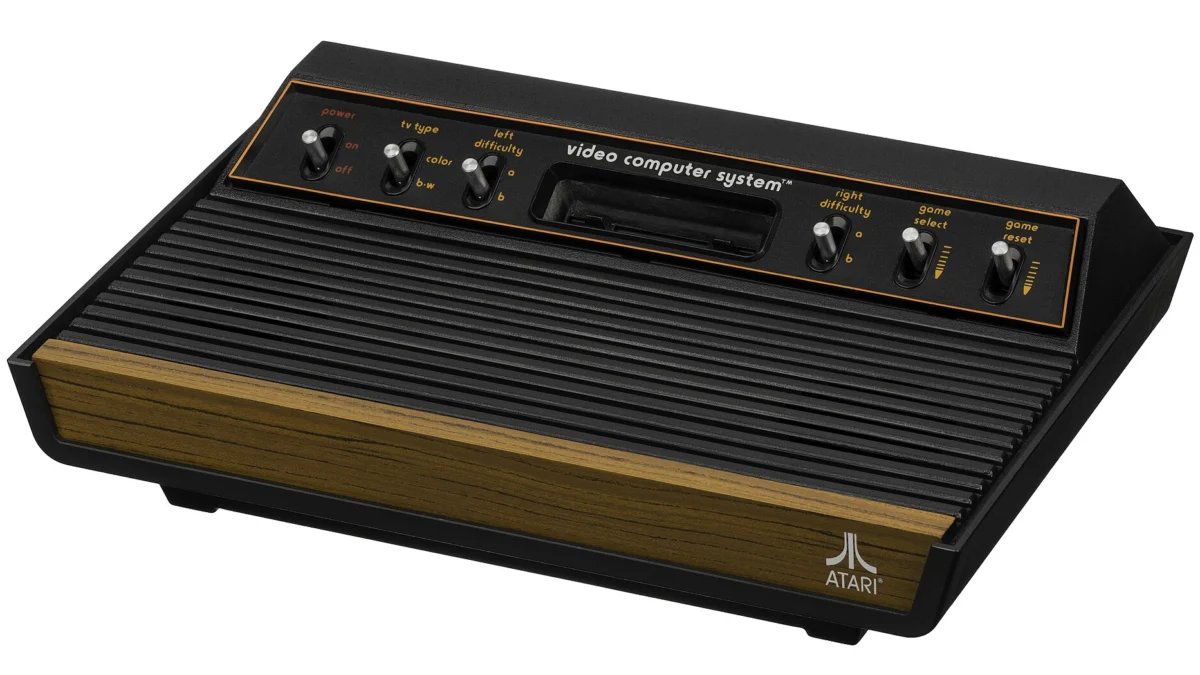
Number 6: The Atari VCS Sold Over Twenty Million Units
Atari released its Video Computer System in 1977, later renamed the Atari 2600, and it became the first widely successful video game system — selling more than twenty million units through the nineteen-eighties.
The number that matters more is a different one. By the time the last of Atari’s 8-bit consoles were made in 1990, more than nine hundred game titles had been released for the platform.
Nine hundred. That is what separates a product from an ecosystem. A console that ships with games is a toy you will finish. A console with a library that keeps growing for thirteen years is a standing invitation, and it changes the household’s relationship with the machine — from a thing bought once to a thing supplied continuously.
It is also why the cartridge slot became the defining feature. The slot was a promise that this was not everything, that more was coming, that the birthday after next had something in it for you.
The hardware sold once. The slot kept selling forever.
Source: computerhistory.org
Number 7: A Magazine Meant to Be Annual Went Monthly in a Year
In 1981 Joyce Worley Katz, Arnie Katz and Bill Kunkel founded Electronic Games, the first video game magazine in the United States.
The plan was for an annual publication. One issue a year, a round-up, a survey of what had come out. Within a year of the first issue it was a monthly.
That accidental acceleration is a better measure of what was happening in 1981 than any sales figure. Three experienced people looked at the field, estimated it generated roughly twelve months of material per year, and were wrong by a factor of twelve.
What a monthly magazine created was something the industry had not had: a shared vocabulary. Reviews, previews, high-score tables, arguments. Before the magazine, your opinion of a game was formed by you and whoever was standing next to the cabinet. Afterwards there was a national conversation with a print schedule, and schoolchildren who had never met were disagreeing about the same things.
Games stopped being something you played. They became something you followed.
Source: computerhistory.org
Number 8: Tron Made the Inside of a Computer a Place
Disney released Tron in 1982, and the use of computer-generated graphics in film took a visible step forward. It was one of the first movies to use such graphics at length.
But the more durable thing Tron did was structural rather than technical. Its plot followed a hacker, and it treated the interior of a computer as a landscape — somewhere with geography, residents, rules, and consequences. Not a tool. A destination.
That metaphor stuck so thoroughly that it is now invisible. We talk about going online, entering a site, visiting a page, being somewhere on the internet. All spatial, all inherited from a way of thinking about computers that a film made mainstream in the same year the Commodore 64 went on sale.
For a lot of children, the machine on the dining table and the world in the film arrived in the same twelve months, and it was not entirely obvious that the second one was fiction.
Tron did badly at the box office and won the argument anyway.
Source: computerhistory.org
Number 9: The NES Launched With Eighteen Games and a Plumber
By the mid-eighties the American game industry was in serious trouble. Then Nintendo released the Nintendo Entertainment System in the United States in 1985, and the fortunes of the business started to reverse.
The system launched with eighteen available titles. Eighteen is a deliberate number. It is not the two or three a hardware company ships when it is proving a machine works, and it is not the hundreds a mature platform accumulates. It is enough that a shop shelf looks stocked and a buyer believes the thing has a future.
And it was largely responsible for turning Mario the Plumber into one of the most enduring characters in the history of video games.
Consider how odd that is. Not a soldier, not a pilot, not a spaceship. A plumber. A small round man with a moustache and a trade, who is famous in countries where the games he appeared in were never officially sold.
The machine that rescued the industry did it with a character whose defining quality was that he looked like somebody’s uncle.
Source: computerhistory.org
Number 10: Steve Jobs Paid Ten Million Dollars for a Graphics Department
Lucasfilm had launched a Special Effects Computer Group in 1979. In 1986, Apple co-founder Steve Jobs paid ten million dollars to buy it and renamed it Pixar.
At the time this was a hardware purchase. The group built expensive graphics machines for imaging work, and that was the business being acquired. Nobody involved was buying a film studio, because there was no such thing as a computer-animated film studio to buy.
Ten million dollars, in 1986, for a division of a company that made science fiction movies.
The story of what that group became is well known enough that it does not need repeating here. What is worth noticing is the shape of it: a games and effects lineage, running from wire-frame Death Stars through graphics hardware, arriving eventually at animated features that made computer graphics completely ordinary for audiences who had no interest in computers at all.
The purchase looked like an eccentric side project. It was the last step of the journey from the university basement to the living room — and then straight past it, into the cinema.
Source: computerhistory.org
Thirty-four years separate a Cambridge student’s noughts and crosses from a ten-million-dollar cheque for a graphics department. In between, the decisive moves were rarely technical. They were decisions about who the audience was: a drinker in a bar, a family with one television, a reader who wanted more than one issue a year.
The technology was necessary. It was almost never the reason anything worked.
What was the first game you played that made you want to play it again — and where were you standing?