Retro Technology 10 min read
10 Home Computers That Taught Us What Computing Cost
Before anyone said the word laptop, a computer was a box you saved up for. Here is what ten of them actually cost, and what you got.
There was a moment, somewhere between the first Star Wars film and the first Live Aid concert, when a computer stopped being a thing your father’s employer owned and became a thing your family might buy. Not easily. Not casually. You saved for it the way people saved for a washing machine, and when it arrived it sat on the dining table because nobody had invented a desk for it yet.
What gets forgotten now is the arithmetic. We remember the beige plastic and the sound of a cassette loading, but the numbers have drained out of the memory. These machines were expensive in a way that is hard to feel today, when a phone costs more than most of them did and nobody blinks. A computer in 1981 could cost more than a second-hand car.
So here are ten of them, with the prices attached. Not the machines that historians pick, necessarily — the ones that showed up in ordinary houses, in school computer rooms, in the corner of a shop window with a handwritten card taped to the monitor. Each one taught a household the same lesson in a slightly different accent: this is what computing costs, and this is what you get for it.
You may have owned one of these. You almost certainly wanted one.
Number 1: The TRS-80 Sold Ten Thousand Units in a Month
Tandy did the maths before launch and decided it could reasonably shift three thousand of these in the first year. In the first month it sold ten thousand.
The machine that caused that was the TRS-80, priced at $599.95. For the money you got a Z80 microprocessor, a video display, four kilobytes of memory, a built-in BASIC interpreter, and cassette storage. What you also got, and this mattered more than the specification list suggests, was a manual written on the assumption that you knew nothing at all. No prior knowledge required. That sentence sounds unremarkable now. In 1977 it was close to radical, because every other route into computing ran through a hobbyist club or a university.
Radio Shack had roughly three and a half thousand stores. That is the part people underrate. You did not have to find a specialist dealer or mail a cheque to California. You could walk into a shop you already used for batteries and fuses, and walk out with a computer.
The company that expected to sell three thousand had accidentally proved there was a queue.
Source: computerhistory.org
Number 2: The Commodore PET Arrived Fully Assembled and Slow
The PET — Personal Electronic Transactor, a name that sounds like it was reverse-engineered from the acronym, because it was — came fully assembled with either four or eight kilobytes of memory and a chiclet keyboard that anyone who typed on it can still describe with feeling.
Fully assembled was the selling point. Plenty of early machines arrived as kits, which meant the first evening with your new computer was spent with a soldering iron. The PET arrived working.
Its storage was the built-in Commodore 1530 Datasette, a cassette deck grafted onto the side of the machine. The museum’s own description of the method is generous and accurate at the same time: cost-effective and reliable, but also very slow. That is the politest possible way to describe pressing PLAY and then leaving the room.
Loading a program from tape was not a task. It was an interval. You put the tape in, started the load, and went to do something else, because you had several minutes and no way to speed them up. Children learned patience from a machine that had no idea it was teaching anything.
Nobody misses the wait. A surprising number of people miss the sound.
Source: computerhistory.org
Number 3: The Apple II Shipped With a Game in the Box
The Apple II came complete: main logic board, switching power supply, keyboard, case, manual, game paddles, and a cassette tape with the game Breakout on it.
Read that list again and notice the last three items. Paddles. A manual. A game. Apple had decided, at the moment of unboxing, that the first thing you should be able to do with your new computer was play with it. Not configure it. Not learn it. Play.
That decision moved the machine out of the hobbyist world that had been Apple’s entire customer base until then and into houses where nobody had any intention of writing code. The Apple II found popularity far beyond the people who had been waiting for it.
It also refused to die. Millions were sold between 1977 and 1993 — sixteen years, which makes it one of the longest-lived lines of personal computers ever built. A machine introduced when Jimmy Carter was in his first year was still being sold when Bill Clinton was in his.
Everyone else was selling a computer. Apple sold an afternoon.
Source: computerhistory.org
Number 4: The TI-99/4 Put a Serious Processor in a Family Machine
Texas Instruments built the TI-99/4 around its own TMS 9900 microprocessor, running at three megahertz, and in doing so gave a home computer one of the fastest CPUs then available in that class of machine.
This is the kind of detail that meant nothing to the family buying it and everything to the fourteen-year-old in the house who read the specification page in the shop and then argued about it at school. Processor speed became a playground currency in a way that seems absurd now and made perfect sense at the time. Nobody could check. Everyone had an opinion.
Texas Instruments was not a computer company in the way Apple or Commodore were computer companies. It made calculators, chips, and industrial electronics, and it arrived in the living room from a completely different direction — as a components manufacturer that happened to have a processor and decided to build a box around it.
The machine sold well and led to a series of TI follow-on models, which is a quiet result for a company that was, at the time, one of the largest electronics firms on earth.
Sometimes the specification wins the argument and the company still loses the decade.
Source: computerhistory.org
Number 5: The Osborne 1 Weighed Twenty-Four Pounds and Called Itself Portable
Twenty-four pounds. Eleven kilos. That is the weight of a large bag of potatoes, and it is what the first mass-produced portable computer asked you to carry.
The Osborne 1 cost $1,795 and gave you a five-inch display, sixty-four kilobytes of memory, a modem, and two 5.25-inch floppy drives. The screen was five inches measured on the diagonal. People used it to write entire books.
The pricing trick underneath it was the genuinely clever part. Bundled with the machine was productivity software worth roughly $1,500 on its own. So the arithmetic a buyer did in the shop was not “is this computer worth $1,795” but “the software is $1,500, so the computer is $295.” That is a completely different question, and it has a much easier answer.
Portable, in 1981, did not mean you carried it around. It meant that moving it between your office and your house was merely unpleasant rather than impossible. The handle was real. So was the shoulder ache.
We got the word before we got the thing.
Source: computerhistory.org
Number 6: The BBC Put a Computer Course on Prime-Time Television
In 1981 a national broadcaster looked at the home computer and decided it was a literacy problem.
The BBC’s Computer Literacy Project set out, in its own words, to introduce interested adults to the world of computers, and it did it by putting a programme called The Computer Programme on television. Not a children’s show. Not a late-night technical slot. A mainstream series aimed at adults who had no idea what any of it meant and were not embarrassed to say so.
Then the BBC did something no broadcaster would attempt today. It commissioned a machine. Acorn built the BBC Microcomputer System so that viewers could own the exact computer they were watching someone use, type the exact programs shown on screen, and get the same result.
Television was the interface. You watched, you copied, you understood. Schools across Britain filled up with the machine, which is why an entire British generation’s first experience of programming has a specific beige box attached to it.
An entire country was taught to code by a television channel, and nobody thought that was strange.
Source: computerhistory.org
Number 7: The Commodore 64 Still Holds the Record
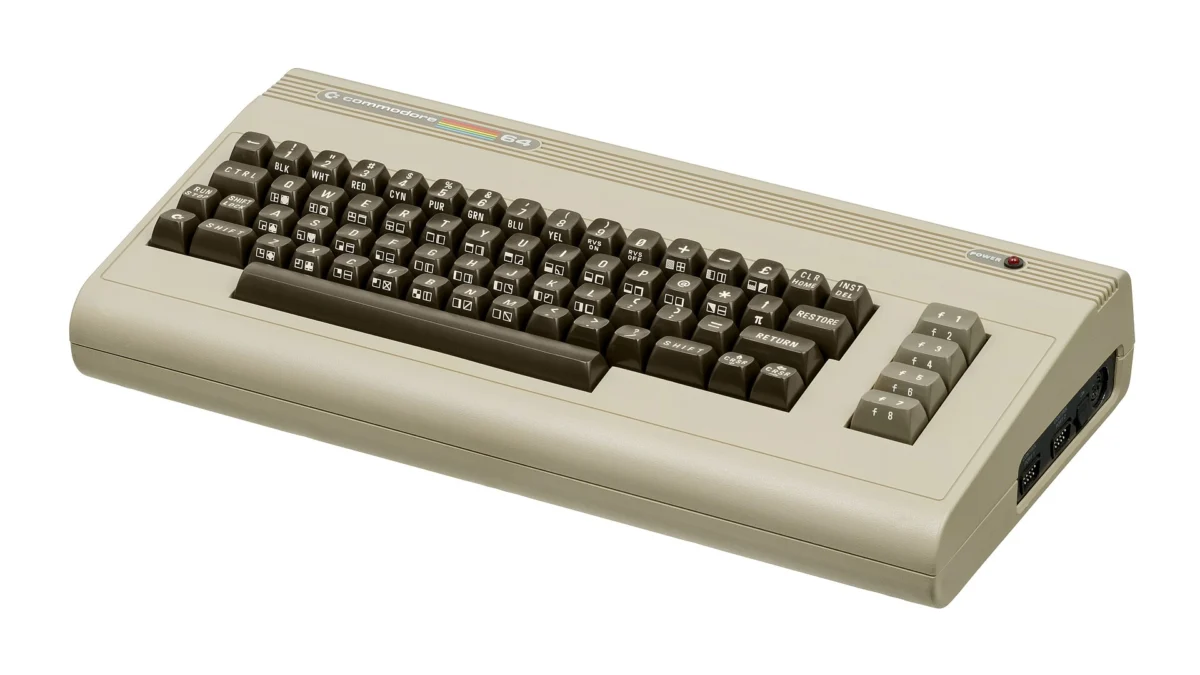
Five hundred and ninety-five dollars, sixty-four kilobytes of RAM, and graphics that embarrassed machines costing twice as much.
The C64 went on sale in 1982 and stayed on sale until 1993. Over those eleven years it sold more than twenty-two million units, and in 2006 the Guinness Book of World Records recognised it as the greatest selling single computer model of all time. That record was set by a machine whose entire memory would not hold one modern photograph.
Volume like that changes what a computer is. Thousands of software titles were released for the C64 over its life, because thousands of titles were commercially sensible when the installed base was that enormous. Software attracted buyers, buyers attracted software, and the loop ran for a decade.
For a lot of households this was simply what the word computer meant. Not a category. A specific brown wedge of plastic with a cartridge port, sitting in front of the family television because it did not come with a monitor and nobody was buying a second screen.
Some machines define a decade. This one outlived the decade that defined it.
Source: computerhistory.org
Number 8: Compaq's First Year Beat Every Startup in American History
Compaq advertised its Portable as the first one hundred per cent IBM PC-compatible computer, which sounds like a technical boast and was actually a legal one.
The claim mattered because IBM’s own PC had already become the standard in offices, and the question everyone asked about any cheaper machine was whether it would run the software they had already bought. Compaq’s answer was yes, all of it, exactly.
The market’s response was immediate. Compaq recorded first-year sales of $111 million — at the time the most ever recorded by an American business in a single year. Not the most by a computer company. The most by any American company, in its first year, ever.
What that success opened was not one product line but an entire category. The IBM-compatible clone market that Compaq launched had taken eighty-three per cent of the personal computer market by 1996. Every beige tower bought from a catalogue through the nineties traces back to this machine proving the thing could legally be done.
IBM set the standard. Somebody else collected on it.
Source: computerhistory.org
Number 9: The Amiga 1000 Was Launched by Andy Warhol and Debbie Harry
Commodore did not announce the Amiga 1000 at a trade show. It announced it at New York’s Lincoln Center, with Andy Warhol and Debbie Harry of Blondie on stage.
Warhol used the machine to paint a portrait of Harry, live, in front of the audience. A computer launch staged as an art event, at a concert hall, with a pop star and the most recognisable artist alive.
The machine could support it. At $1,295 without a monitor, the Amiga 1000 had audio and video capabilities beyond what most other personal computers of the period could manage, which is why it ended up in places other home computers never reached — television graphics departments, music studios, video editing suites.
It also explains the peculiar devotion Amiga owners still have. Most people who owned a home computer in the eighties used it for games and homework. Amiga owners had a machine that could do professional work, at a price a household could just about justify, and they have never entirely stopped mentioning it.
The specification was ahead of its time. So, unfortunately, was the launch party.
Source: computerhistory.org
Number 10: A Student's $795 Machine Rewrote How Computers Were Sold
The company was headquartered in a university dormitory room. It sold IBM PC-compatible computers assembled from stock components, and it did well enough that its founder dropped out of school to run it.
In 1985 that company produced the first computer of its own design, the Turbo PC, and sold it for $795.
Look at what that price is doing. The Osborne 1 had cost $1,795 four years earlier. The IBM PC-compatible market that Compaq opened had been colonised so thoroughly that a student building machines from off-the-shelf parts could undercut everyone and still make money.
The innovation was never the hardware. It was the absence of a shop. No retail floor, no dealer margin, no distributor taking a cut — the machine went from the assembly bench to the customer, and the saving went into the price. That founder was Michael Dell, and the model he was testing in a dorm room became the default way computers were sold for the next twenty years.
The machine was ordinary on purpose. That was the whole idea.
Source: computerhistory.org
Line the prices up and a pattern appears. In 1977 a working home computer cost around $600. In 1981 a portable one cost $1,795. By 1985 a student in a dormitory was selling a capable machine for $795 by removing the shop from the transaction.
What changed was not only the technology. It was the assumption that a computer was a rare purchase that needed a salesperson to explain it.
Which of these was the one in your house — and do you remember what your family gave up to pay for it?