Retro Technology 9 min read
10 Ways We Stored Things Before the Cloud Existed
A reel of tape you could carry. A disk pack that weighed ten pounds. Here is what holding your own data actually felt like.
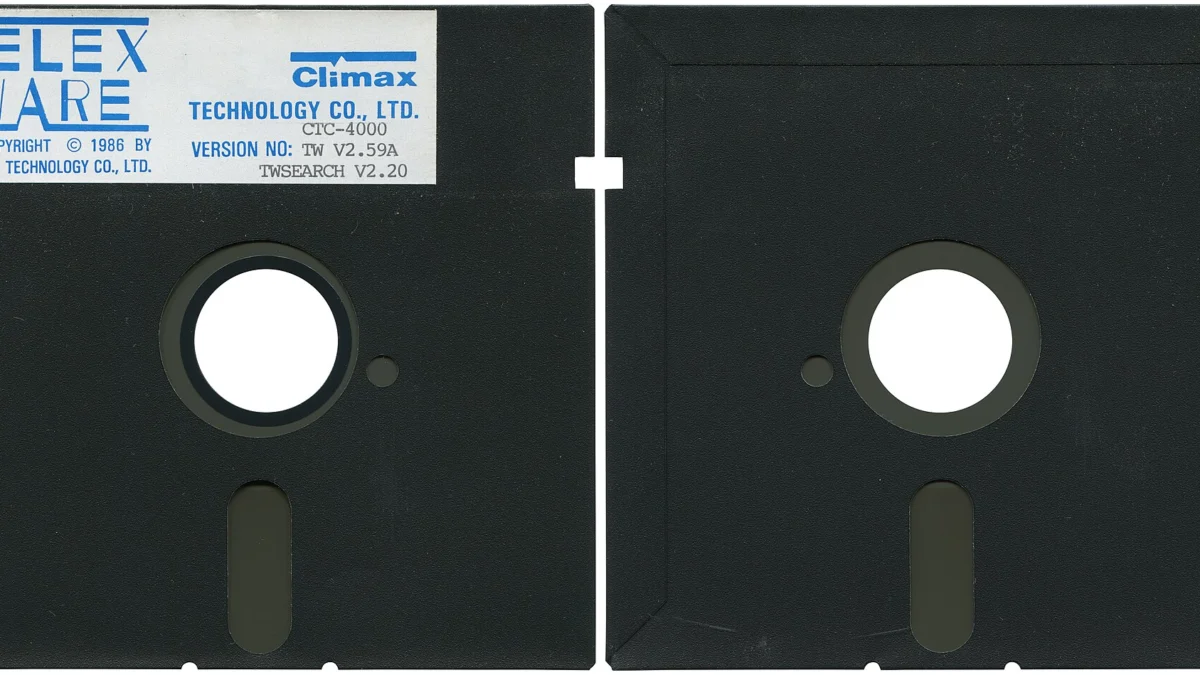
There is a physical memory that anyone over forty still carries: the weight of your own files. A box of floppies. A shoebox of cassettes. A binder with plastic sleeves, each one holding a disk with a handwritten label that made sense at the time and does not now.
Storage used to be an object. You could drop it, lose it, leave it at a friend’s house, or find it years later in a drawer and have no way to read it. It took up space on a shelf, and when you ran out of space you had a decision to make about what mattered.
That is gone, and it went quietly. Nobody marked the day their files stopped being things.
What follows is the physical history of that idea — ten ways people held on to information before holding on to it stopped requiring anywhere to put it. Some of these you used. Some of them were the size of a wardrobe and cost more than the building they stood in.
They all did the same job. The difference is only how much of your life they took up while doing it.
Number 1: A Tape Reel Held 1.4 Million Digits and Weighed Three Pounds
In 1951 the UNISERVO tape drive arrived with the UNIVAC I — the first tape storage device built for a commercial computer.
Each reel weighed about three pounds and held 1,440,000 decimal digits, read at a hundred inches per second. Three pounds. You could pick up your organisation’s records and walk them to another room.
What made magnetic tape so popular was not capacity alone. It was the combination of relatively low cost, portability, and what the museum’s own description calls unlimited offline capacity — meaning that when a reel filled up, you took it off and put another one on, and the only real limit was how many reels you were willing to store.
That is a filing cabinet, conceptually. It is the same logic as paper, with the paper replaced by something a machine could read.
For the next forty years, the answer to “where is the data” was a physical direction you could point in.
Source: computerhistory.org
Number 2: The First Hard Disk Was Fifty Platters and Five Million Characters
In 1956 IBM shipped a RAMAC 305 to Zellerbach Paper in San Francisco, and the era of magnetic disk storage began.
The drive at the centre of it consisted of fifty magnetically coated metal platters, together capable of storing about five million characters of data. Five megabytes, in a machine the size of a large piece of furniture, sold to a paper company.
The reason it mattered has nothing to do with capacity and everything to do with the word random in its name. Tape is sequential: to reach something in the middle you wind through everything before it. A disk lets the head move to the right place directly. The difference between those two things is the difference between a scroll and a book, and it is the reason every storage device you have used since works the way it does.
A working RAMAC assembly is still demonstrated regularly at the Computer History Museum, which means you can watch the ancestor of your laptop’s drive move.
The first hard disk was not small, cheap or fast. It was simply the first one you did not have to rewind.
Source: computerhistory.org
Number 3: The IBM 1311 Made Storage Something You Could Carry Out
Announced on 11 October 1962, the IBM 1311 was the first disk drive IBM built with a removable disk pack.
Each pack held six disks, weighed about ten pounds, and stored two million characters. Ten pounds is a full bag of shopping. People lifted these, carried them across offices, and slotted them into drives.
The removable pack solved a problem that the RAMAC had created. A fixed disk is fast, but its capacity is its capacity — when it is full, you buy another machine. A removable pack separates the reader from the data, which means one expensive drive can serve an unlimited amount of storage, as long as somebody is willing to do the lifting.
Every removable format that followed inherited this logic: the cartridge, the floppy, the memory card, the USB stick. One reader, many objects, and the object is the thing you own.
It also introduced an anxiety that lasted fifty years. The data was now something you could physically drop.
Source: computerhistory.org
Number 4: The First Floppy Disk Was Eight Inches and Read-Only
The work produced a read-only, eight-inch, eighty-kilobyte floppy disk and drive — the world’s first. Released as the IBM 23FD in 1971, it was used with the System 370 among other computers.
Read-only. The first floppy disk could not be written to by the person holding it. It existed to get information into a machine, not to get information out.
That constraint tells you what the original problem was. Large computers needed their operating instructions loaded at startup, and the existing method involved punched cards or tapes that were slow, bulky and easy to damage. A thin flexible disk in a sleeve was cheap to produce, cheap to post, and small enough to sit in a drawer.
Eighty kilobytes. Less than a single photograph from a modern phone. And it was designed, at that capacity, purely to carry instructions in one direction.
The most familiar storage object of the next twenty-five years started life as a delivery mechanism, not a place to keep anything.
Source: computerhistory.org
Number 5: The Datasette Turned a Cassette Deck Into a Disk Drive
When the Commodore PET arrived in 1977, its primary storage device was the built-in Commodore 1530 Datasette — data plus cassette, a name that explains itself.
It used ordinary audio cassette technology to store computer data, and the Computer History Museum’s summary of the method is exact: cost-effective and reliable, but also very slow.
Every word there is doing work. Cost-effective, because cassettes and the mechanisms to read them were already mass-produced for music, so a home computer could inherit an entire manufacturing industry rather than build one. Reliable, because the technology was mature. Very slow, because audio tape moves at the speed audio tape moves at, and no amount of wanting will change it.
You started a load and you left. Made a drink. Did your homework. Came back and found out whether it had worked.
The Datasette is the reason an entire generation associates computing with waiting, and associates waiting with a specific mechanical hiss.
Source: computerhistory.org
Number 6: Hewlett-Packard Settled the Floppy Format War in 1982
By the early eighties there were several competing candidates for the small floppy standard: three-inch, three-and-a-quarter-inch, 3.9-inch, and three-and-a-half-inch.
The first significant company to adopt the three-and-a-half-inch floppy for general use was Hewlett-Packard, in 1982 — an event described as critical in establishing momentum for the format and helping it prevail over the other contenders.
That is how a standard actually gets chosen. Not by a committee deciding which is best, and not by the market slowly discovering the truth. A large, credible buyer picks one, and the weight of that decision pulls everyone else along.
The winner became the object you still recognise: rigid plastic shell, sliding metal shutter, the little write-protect tab you flicked with a fingernail. It is the save icon. Millions of people who have never touched one press its picture every day.
The shape that outlived every machine that used it was chosen because one company had to buy something.
Source: computerhistory.org
Number 7: The Bernoulli Box Ranged From 5MB to 230MB
Released in 1983, the Bernoulli Box allowed many times the amount of storage afforded by a regular floppy disk, with cartridges in capacities ranging from five megabytes to two hundred and thirty.
Look at that range. The smallest cartridge in the family and the largest differ by a factor of forty-six, and they were the same product line. Storage was moving so fast in the eighties that a single format had to stretch across nearly two orders of magnitude just to stay on sale.
The Bernoulli Box occupied a specific and now-vanished category: the thing you bought when floppies had become genuinely insufficient but a hard disk was still an expensive, fixed, fragile proposition. Design studios had them. Small firms had them. Anyone working with images had them, because images were the first ordinary files that got big.
It is the ancestor of the external drive sitting next to a lot of desks right now, doing the identical job for the identical reason.
Some categories never disappear. They just stop having a brand name attached.
Source: computerhistory.org
Number 8: A Tape Cartridge Held 92MB on Half-Inch Tape
CompacTape was introduced in 1984, developed by Digital Equipment Corporation for its VAX family of computers. The drive wrote twenty-two data tracks back and forth on half-inch tape, and originally held ninety-two megabytes.
Back and forth is the detail worth pausing on. Rather than one long pass, the head wrote a track to the end of the tape, then reversed and wrote the next track on the way back, twenty-two times. All the engineering ingenuity of the period, spent on the problem of getting more out of a physical length of ribbon.
The technology was purchased by Quantum in 1994, and nearly twenty years after its introduction, SuperDLT could hold up to eight hundred gigabytes.
Ninety-two megabytes to eight hundred gigabytes, in the same lineage — a factor of roughly nine thousand, while the object stayed a cartridge you could hold in one hand.
Tape was written off as obsolete for four decades and kept quietly outliving the things that replaced it.
Source: computerhistory.org
Number 9: An Encyclopedia Used Twelve Per Cent of One CD-ROM
Philips and Sony announced the CD-ROM format in 1984. The first general-interest product released afterwards was Grolier’s Electronic Encyclopedia, which came out in 1985.
The nine million words in that encyclopedia took up twelve per cent of the available space.
Sit with that figure. An entire general encyclopedia — the object a family saved for, the shelf of matching spines that signified a household took education seriously — fitted into roughly an eighth of one disc, leaving the rest empty.
That single statistic ended a category of furniture. Not immediately, and not because anyone announced it, but the arithmetic was now public and could not be unlearned. Whatever a printed encyclopedia was worth, it was not worth the space it took up.
Everything that followed on optical disc — the games, the clip art, the software that arrived in a cardboard sleeve — was made possible by that same excess of room.
The disc was not better than the books. It was simply so much larger than the problem that the problem stopped existing.
Source: computerhistory.org
Number 10: IBM Replaced Reels With a Four-by-Five-Inch Cartridge
Announced in March 1984, IBM’s 3480 cartridge tape system set out to replace the traditional reels of magnetic tape in the computer centre with a cartridge measuring four inches by five, holding two hundred megabytes and offering faster access.
Those spinning reels are the image every film uses when it wants to signal computer. Two white circles turning behind glass. By 1984 IBM was actively trying to get rid of them, because a reel has to be threaded, and threading is a job, and a job is a person, and a person is slow.
The cartridge did away with all of that. You pushed it in. The machine did the rest.
What is easy to miss is how recent this is. The reel-to-reel computer room is a nineteen-sixties image, but it was still standard equipment in the mid-eighties, which is why a visual shorthand that was already being retired outlived the technology by fifty years.
The cartridge won everywhere except in the way we picture the thing it replaced.
Source: computerhistory.org
Line them up and the pattern is not really about capacity. It is about handling. A three-pound reel, a ten-pound disk pack, an eight-inch sleeve, a cartridge you pushed in with one hand. Each step made the data lighter to move and easier to forget where you put.
We finished the job. Nothing weighs anything now, and nothing has a shelf.
What is still sitting in a box in your house that you have no machine left to read?