Retro Technology 8 min read
10 Gadgets That Rewired the 1990s Household
A keyboard that unfolded. A disk that replaced a shoebox. A toy that sold for three hundred dollars second-hand.
The nineties were the decade the household filled up. Not with furniture — with devices that each had one job, their own power supply, and a manual nobody read.
A drawer somewhere in your house probably still holds the residue: a cable that fits nothing, a docking cradle, a rechargeable battery that has not held a charge since the Blair government. These were expensive items, bought deliberately, and most of them were replaced by a single rectangle of glass within fifteen years.
What is easy to lose is how experimental it all was. Nobody knew what shape a portable computer should be, so companies tried everything — keyboards that unfolded, handwriting recognition, screens that flipped, disks that were slightly bigger than the disks you had.
Ten of those attempts are below. Some of them were vindicated completely. Two of them failed in public, expensively, and turned out to be right about everything except the year.
You owned at least three of these. Be honest about which.
Number 1: The PowerBook Invented Where Your Hands Go
Apple’s Macintosh Portable had met with little success, and that failure led to a complete redesign of the company’s portable line. What came out in 1991 was the PowerBook.
All three models introduced that year featured a built-in trackball, an internal floppy drive, and palm rests — and those palm rests would go on to become typical of nineties laptop design.
Palm rests sound like nothing. They are the most consequential item on that list.
Before them, portable computers put the keyboard at the front edge of the case, which meant your wrists hung in the air or rested on the desk below the machine. Moving the keyboard back and leaving a flat area in front of it created somewhere to put your hands and, not incidentally, somewhere to put a pointing device that was not a mouse needing a table.
Open any laptop made since and look at the layout. That arrangement was a decision made once, in response to a product that had not sold.
The failure was the expensive part. The fix was free.
Source: computerhistory.org
Number 2: The Newton Was Right About Everything Except the Date
Apple entered the handheld computer market in 1993 with the Newton.
It is remembered as a failure, and commercially that is accurate. It is also the device that gave the English language the phrase personal digital assistant, and it is a reasonable description of a product category that eventually sold in the billions.
A flat screen. No keyboard. Input by touching it. Something you carried rather than something you sat at.
Every one of those decisions is now simply what a portable computer is. The Newton got the form right and arrived with handwriting recognition that could not reliably do the one thing the whole interface depended on, which is a brutal way to fail — not because the idea was wrong, but because one component was not ready.
Apple would return to almost exactly this shape fourteen years later with a different input method and considerably better timing.
Being early enough is a skill. Being this early is just expensive.
Source: computerhistory.org
Number 3: IBM Built a Keyboard That Unfolded When You Opened the Lid
The ThinkPad 701C, released in 1995, had a full-sized keyboard inside a machine too small to contain one.
It worked by mechanism. Officially called the Track Write and designed by the inventor John Karidis, the keyboard automatically expanded as the lid opened — two halves sliding apart and interlocking into a full layout that was visibly wider than the computer holding it.
Watch a video of one opening and it still looks like a magic trick. The thing grows.
This is the most nineties engineering decision in this entire list. Faced with the conflict between portable size and usable typing, the answer was not to compromise on either but to build a moving mechanical system with interlocking parts into a laptop, and to ship it.
The industry eventually solved the problem by making laptops slightly bigger and keys slightly flatter, which is sensible and dull.
For one year, the sensible answer lost to the spectacular one.
Source: computerhistory.org
Number 4: The Palm Pilot Made People Learn a New Alphabet
Palm Inc., founded by Ed Colligan, Donna Dubinsky and Jeff Hawkins, released its first devices — the Palm 1000 and 5000 — built around a Motorola microprocessor running at 16 megahertz.
Input was by Graffiti, a special gestural input language described as quick to learn and fast.
Look closely at what that means. The Newton had tried to read your handwriting and struggled. Palm inverted the problem: instead of the machine learning your letters, you learned the machine’s. Each character had one stroke, unambiguous, designed for recognition rather than for looking like writing.
Hundreds of thousands of adults voluntarily learned a modified alphabet to operate a pocket device, and by all accounts did not find it a hardship.
Nobody would accept that today, which tells you something about how much people wanted this to work. The compromise was not a flaw in the product. It was the product.
Sometimes the winning move is to stop trying to be intuitive and just be reliable.
Source: computerhistory.org
Number 5: The Zip Disk Sold a Problem Everyone Suddenly Had
Iomega released the Zip Disk in 1994, into a gap nobody had needed filled five years earlier.
The floppy had been sufficient for a long time, because the things ordinary people made were small — documents, spreadsheets, saved games. Then scanners arrived, and digital images, and sound files, and suddenly a single object could not fit on a single disk.
The Zip sat precisely in that gap. Bigger than a floppy, cheaper and more portable than a hard drive, and shaped closely enough to the thing it replaced that no explanation was needed. It went in a drive. It had a label. You wrote on the label.
For roughly six years it was everywhere in design studios, offices and schools, and then it disappeared so completely that most people under thirty have never seen one.
It did not fail. It solved a problem that only existed between two other technologies, and when the gap closed the product had nowhere left to stand.
Source: computerhistory.org
Number 6: CompactFlash Won by Being Boring
SanDisk introduced CompactFlash in 1994, and it was quickly adopted — becoming the preferred memory storage option in consumer and professional electronic devices alike.
Consumer and professional. That combination is the whole story, and it is rarer than it sounds. Formats usually split: one for people who care about cost, another for people who care about performance, and the two never meet.
CompactFlash did not split. The same card went into a point-and-shoot camera a family bought for a holiday and into professional equipment used for paid work. One supply chain, one form factor, two markets that normally have nothing to do with each other.
There was nothing charismatic about it. No launch event, no advertising campaign, no design anyone remembers. It was a rectangle with pins.
Solid-state storage entered ordinary life through a product so unremarkable that almost nobody noticed it arriving — which is, on the evidence, a very effective way to change everything.
Source: computerhistory.org
Number 7: The First Commercial DVD Was a Film About Tornadoes
The Digital Video Disc format was introduced in 1995, with a storage capacity representing a huge increase over the common compact disc, in both read-only and read-write forms.
The first commercial DVD release was Twister.
There is something perfect about that. Not a prestige film, not a restoration of a classic, not anything chosen to demonstrate visual subtlety. A disaster movie about tornadoes, picked because what a new format needs to demonstrate is loud weather.
The DVD was adopted widely by the film industry for consumer releases, and in doing so it changed a household habit that had run for nearly twenty years. No rewinding. No tape degrading with each watch. No tracking adjustment. And, quietly, no more recording things off the television onto the same object.
The tape was a medium you could write on. The disc, for most families, was one you could only read.
We gained quality and gave up something we did not realise was a feature.
Source: computerhistory.org
Number 8: The PlayStation Sold More Than a Hundred Million Units
Sony, an electronics giant with no history in the games business, released the PlayStation in Japan in 1994 and in the United States a few months later.
It sold more than a hundred million units and established Sony as a dominant player in home gaming.
The number is remarkable. What is more remarkable is who bought it. The console arrived with an audience that had grown up: the children who had an Atari in 1980 were in their twenties by the mid-nineties, with jobs and their own homes, and the industry had never before had to consider whether adults would keep playing.
A hundred million units is not a children’s toy market. It is evidence that people stopped ageing out of the habit, which had been everyone’s reasonable assumption until then.
The generation that was supposed to grow out of video games simply did not, and the entire modern industry is built on that single failed prediction.
Source: computerhistory.org
Number 9: A Furby Resold for Three Hundred Dollars
The Furby ignited a buying frenzy in the 1998 holiday season, with resale prices reaching three hundred dollars.
Three hundred dollars. For a battery-powered toy that blinked, made noises, and appeared to learn a few words of English over several days.
The appeal was the appearance of learning. A Furby started out speaking its own invented language and gradually replaced it with English, and to a child — and to a surprising number of adults — that felt like teaching rather than unpacking. The toy was not learning anything. It was revealing, on a timer, vocabulary it had shipped with.
That is worth sitting with, because it is the first time a mass consumer product used the illusion of a mind as its main feature, and it worked well enough to distort a national retail market for one December.
We have had a great deal of practice since at paying a premium for things that seem to be listening.
Source: computerhistory.org
Number 10: The Bondi Blue iMac Cost About $1,300
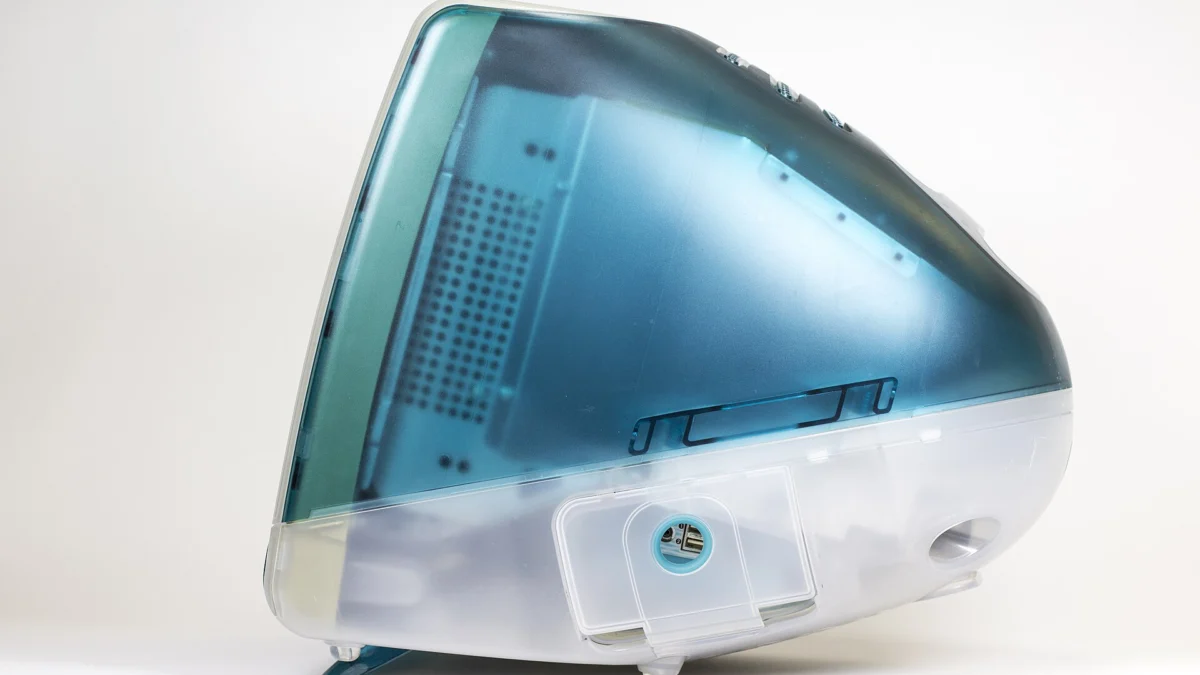
Apple launched the iMac in 1998 — an all-in-one desktop in a translucent blue-green case, selling for around thirteen hundred dollars.
It was the first new product under a returning Steve Jobs, and many consider it the most significant step in Apple’s recovery from near-bankruptcy in the middle nineties.
The colour is what everyone remembers, and the colour was the argument. Every other computer on sale was beige or grey, because computers were office equipment and office equipment does not have opinions. The iMac was translucent. You could see inside it. It was named after a beach.
What that said to a buyer standing in a shop was that this object was allowed to live in a room where people also lived — a kitchen, a bedroom, a hallway — rather than in a study set aside for it.
The engineering mattered. But the thing that moved computers out of the spare room was a decision about plastic.
Source: computerhistory.org
Line them up and the nineties look less like progress and more like a search. An unfolding keyboard, a handwriting system nobody could use, an alphabet people learned voluntarily, a disk sized for a gap that closed. Most of these were answers to questions that stopped being asked.
The ones that survived did it by being dull and available, not by being clever.
Which of these is still in a drawer in your house — and do you know where its cable went?